Tuesday, 14 August 2012
Griff says; Reflections from the echo chamber.
We're back in the exciting and slightly crazy world of Irish experimental music today. Those of you who've hung around the Streetlamp for a long time will remember how excited I was back in 2010 when I unleashed Mariel McCormack and Marie O Hara on you (see 'here').
Well, with the release this month of the 9-song album Echo by Niamh de Barra I'm finding myself reaching the same sort of levels of hysteria (Gordon - "Oh, please God, no!").
Niamh de Barra is a classically trained pianist and vocalist from Dublin who has been making music for quite some time now. From 2002, she was part of the now defunct improvisational group John Mary Trilogy, during which period she took up the cello, which now features prominently in her work. In 2008, the band broke up and Niamh began her solo career, initially under the moniker Scurvy Lass. Since returning to her own name, she has released two EPs, ‘Cusp’ (2010) and ‘Below The Sea’ (2012) both of which are avaialable as free digital downloads from her bandcamp page. It was the latter EP which brought her to my attention as it was released on Scotland's own, excellent Black Lantern Music free netlabel. I was really struck by the innovative methods she used to record the tracks on this, layering and looping the vocals and instruments to make something which sounded both traditional and yet completely modern. With this latest release, Niamh employs the same distinctive style, slowly building the songs by layering different textures, to deliver a masterpiece of gothic, folktronica experimentation.
I'm predicting that if you enjoyed recent Streetlamp recommendation Muscles of Joy (see 'here') you'll enjoy this. The other obvious musical reference point is de Barra's compatriot Laura Sheeran.
I'm embedding a couple of songs below for your delectation. Firstly, here's Spooked, a song which manages the odd combination of being both creepy and witty. As its subject matter is riding your bike at night it serves as a nice counterpoint to our recent musical offering on the same subject from Capybara (see 'here'):
Hope you enjoyed that - and musicians aspiring to gain Streetlamp coverage take note; nothing gets you on the Streetlamp quicker than a song about cycling.
Next, here's The Machine, a song which examines the incredible destruction wrought by the deadly loosening of the ravaging forces of free-market capitalism and rather honestly notes de Barra's failure to recognise this during the so-called boom years:
Hope you enjoyed that. The opening lyric asks:
"We say, "Fight Back", but how do you fight the PR machine?
How do you fight against a shadow or an oil-slick?"
The answer, of course, is by forming affinity groups based on the principles of libertarian socialism - but then you knew that already.
Griff
xx
Sunday, 12 August 2012
Open Head Wounds 1: The Melancholia Of Analogue Synths
One of the pivotal moments in my self-tutored musical education occurred in August of 1980 on a Saturday morning. For some reason, the usual Saturday morning kids TV staples, Swap Shop and Tiswas, weren't on, and some gubbins called Fun Factory was on in it's place. During a fairly uneventful show there suddenly appeared a rock band whose unusual name I had heard of, but whom I had never heard. The band were Ultravox, and the song they performed was 'Sleepwalk', their first single with new vocalist Midge Ure (not that I knew that at the time). The song clattered along at a fair old whack making me assume that they were some new Punk band, but I couldn't help but notice that no-one on stage was playing a guitar of any description. What gives?
Of course, it turned out that Ultravox were among the early pioneers of synthesiser driven Pop music. Synths had been used in music since the early 70s with Kraftwerk, Can and David Bowie at the forefront of the new Electronic guard. But since Punk had changed the landscape and a new DIY ethos had taken over, many budding musicians questioned why bother going to all the trouble of learning to play guitar or piano when you could just push a button on a synthesiser and you were off and running.
Early pre-Punk bands like Cabaret Voltaire and Throbbing Gristle had been using synths from as far back as 1975, but had often used them to create atonal ambiance or discordant white noise. The duality of Punk Rock coupled with Bowie's synth-washed Low and "Heroes" albums proved the touchstone for many bands who emerged in the very early 80s. The NME at the time seemed to take a neutral stance; not deriding bands for their lack of musical rootsiness, and also championing the aloof and arty pretensions of some of the more serious synthesiser based acts.
At the time, the synthesiser, in particular the Fairlight synthesiser, was seen as the instrument of the future and was often used unsparingly on TV soundtracks and adverts, on Public Information Films, early video and computer games, and especially on home video distributor's idents. That hollow, unearthly, entirely artificical sound seemed everywhere in 1980 and very quickly became dated, a symbol of the synthetic falseness that many tarnish the 1980s with as a decade.
Yet there is, and practically always has been, an odd melancholy to the tones and notes created by those synthesisers, that now creates a weird mix of Proustian flashback with a memory of looking forward....that those strange sounding, mechanical Pop songs contain memories of futures to come....futures that ended up sounding nothing like the music they created. But even at the time, the very non-humanised textures of the music had a peculiar despondency to them that I'm sure their creators weren't intending as they composed them.
Take for instance 'Almost' by Orchestral Manoeuvres In The Dark....I find this to be one of the most melancholic pieces of music ever performed. The haunting downbeat melody could almost certainly never have been created on a guitar or acoustic piano; it's the very flat, soulless-ness of the instrument that gives the song it's heartbreaking power....
Playing a very similar melody, if an octave lower, is 'The Path Of Least Resistance' by the Human League, long before Phil Oakey acquired two female co-vocalists and chased the great Pop dream. Early Human League records were very serious affairs with pure synthesised instrumentation backing Oakey's stentorian vocal concerns of a dystopian future of mechanised illness and genetic mutation....
In the early 80s it became de riguer for the more serious bands out there to feature synthesisers in their line-up, mostly in place of a lead guitar, but this lead to great deal of critical sniffiness about the 'authenticity' of the music. Whilst no-one ever took a swipe at Kraftwerk for creating beautiful, glacial soundscapes purely on synthesisers, many New Romantic, Futurist or Post-Punk bands were harshly criticised or mocked for their 'plastic soul'.
And yet this didn't seem to stem the flow. Even back in the day when we were forming school bands, Griff was involved in a band that purely played 'authentic' instruments. When he tried to get me into the band, it was on the belief that I would play keyboards (I had a tiny, cheap electronic keyboard at the time), even though the band didn't really need another member, and especially didn't need a synthesiser. But that was the point! I couldn't play guitar, bass or piano, but I could faff about with an electronic keyboard and get in the band!
Just as Punk had liberated music with it's 'anyone can do it' manifesto, so the synthesiser meant that anyone could be in a band even if they couldn't play 'proper' instruments. Whilst this may have led to a few extremely ropey chart acts (Depeche Mode, Howard Jones) it also led to some very fine music indeed.
Take, for example, nearly-rans B-Movie who, despite relentless enthusiastic championing from Kid Jensen, just failed to hit the big time with their excellent singles 'Remembrance Day' and 'Nowhere Girl'....
Then there was The Passage....starting out as contemporaries of The Fall and even once auditioning one Steven Patrick Morrissey of Salford as vocalist, The Passage went from scrappy, scribbly Post-Punk guitar band to being almost entirely synthesised in the space of one album. The Passage made some of the best alternative Pop music of the early 80s, intellectually sharp and musically complex, and really should have scored one of the biggest chart hits of the time with the exceptional 'XOYO', a song whose failure to chart still mystifies me to this day....
(I should point out that I have no idea what the video representing the song below is supposed to signify!!)
And so back to Ultravox....as I became a fan of theirs, so I slowly began finding out more about their past. 'Sleepwalk' wasn't their first single as I had believed, but the band had had a whole 5 year history before that single's release.
Starting in 1975 as Tiger Lily and then changing to Ultravox as Punk broke, the band released three rather fantastic albums and a clutch of singles while fronted by original vocalist John Foxx. I had heard the name John Foxx before as he had released a single called 'Underpass', an odd completely synthesiser based song that I had bought without knowing anything about the singer or his past.
John Foxx was one of my first real musical heroes, just before Adam Ant and Morrissey changed me forever. There was something strangely moving about his entirely computerised music that had a detached alienation coupled with a poetic romanticism. It's no wonder then that Michaelangelo Antonioni asked Foxx to score his 1982 film 'Identification Of A Woman', a sobering study of a film-maker's existential crisis and failure to communicate with the women he is in relationships with.
His early singles all seemed to have a motorised theme running through them; 'Underpass', 'Burning Car', 'No-one Driving', and his debut solo album 'Metamatic' is considered as a high watermark in electronic music. Given that the album was created with nothing but electronic instruments, it still has a soulful beauty perhaps best captured on the track 'Blurred Girl'....
Foxx would go onto create an impeccable body of work taking in dreamy Pop albums ('The Garden'), ambient works ('Cathedral Oceans'), and still proves proficient today, working with longtime collaborator The Maths on a series of critically acclaimed albums.
While his early releases crept into the charts, he has remained a peripheral cult figure and only now is being hailed as true pioneer of electronic music and has finally gained the kudos and respect of even the most synth-phobic out there.
Whilst some of contemporaries and peers may look down upon the synthesiser and the mechanised music they created in the early 80s, I never had a problem with them, and now find their eerie tones and weird modulations a comforting and dreamy recollection of times past....
(to be continued next week....)
~Gordon~
Of course, it turned out that Ultravox were among the early pioneers of synthesiser driven Pop music. Synths had been used in music since the early 70s with Kraftwerk, Can and David Bowie at the forefront of the new Electronic guard. But since Punk had changed the landscape and a new DIY ethos had taken over, many budding musicians questioned why bother going to all the trouble of learning to play guitar or piano when you could just push a button on a synthesiser and you were off and running.
Early pre-Punk bands like Cabaret Voltaire and Throbbing Gristle had been using synths from as far back as 1975, but had often used them to create atonal ambiance or discordant white noise. The duality of Punk Rock coupled with Bowie's synth-washed Low and "Heroes" albums proved the touchstone for many bands who emerged in the very early 80s. The NME at the time seemed to take a neutral stance; not deriding bands for their lack of musical rootsiness, and also championing the aloof and arty pretensions of some of the more serious synthesiser based acts.
At the time, the synthesiser, in particular the Fairlight synthesiser, was seen as the instrument of the future and was often used unsparingly on TV soundtracks and adverts, on Public Information Films, early video and computer games, and especially on home video distributor's idents. That hollow, unearthly, entirely artificical sound seemed everywhere in 1980 and very quickly became dated, a symbol of the synthetic falseness that many tarnish the 1980s with as a decade.
Yet there is, and practically always has been, an odd melancholy to the tones and notes created by those synthesisers, that now creates a weird mix of Proustian flashback with a memory of looking forward....that those strange sounding, mechanical Pop songs contain memories of futures to come....futures that ended up sounding nothing like the music they created. But even at the time, the very non-humanised textures of the music had a peculiar despondency to them that I'm sure their creators weren't intending as they composed them.
Take for instance 'Almost' by Orchestral Manoeuvres In The Dark....I find this to be one of the most melancholic pieces of music ever performed. The haunting downbeat melody could almost certainly never have been created on a guitar or acoustic piano; it's the very flat, soulless-ness of the instrument that gives the song it's heartbreaking power....
Playing a very similar melody, if an octave lower, is 'The Path Of Least Resistance' by the Human League, long before Phil Oakey acquired two female co-vocalists and chased the great Pop dream. Early Human League records were very serious affairs with pure synthesised instrumentation backing Oakey's stentorian vocal concerns of a dystopian future of mechanised illness and genetic mutation....
In the early 80s it became de riguer for the more serious bands out there to feature synthesisers in their line-up, mostly in place of a lead guitar, but this lead to great deal of critical sniffiness about the 'authenticity' of the music. Whilst no-one ever took a swipe at Kraftwerk for creating beautiful, glacial soundscapes purely on synthesisers, many New Romantic, Futurist or Post-Punk bands were harshly criticised or mocked for their 'plastic soul'.
And yet this didn't seem to stem the flow. Even back in the day when we were forming school bands, Griff was involved in a band that purely played 'authentic' instruments. When he tried to get me into the band, it was on the belief that I would play keyboards (I had a tiny, cheap electronic keyboard at the time), even though the band didn't really need another member, and especially didn't need a synthesiser. But that was the point! I couldn't play guitar, bass or piano, but I could faff about with an electronic keyboard and get in the band!
Just as Punk had liberated music with it's 'anyone can do it' manifesto, so the synthesiser meant that anyone could be in a band even if they couldn't play 'proper' instruments. Whilst this may have led to a few extremely ropey chart acts (Depeche Mode, Howard Jones) it also led to some very fine music indeed.
Take, for example, nearly-rans B-Movie who, despite relentless enthusiastic championing from Kid Jensen, just failed to hit the big time with their excellent singles 'Remembrance Day' and 'Nowhere Girl'....
Then there was The Passage....starting out as contemporaries of The Fall and even once auditioning one Steven Patrick Morrissey of Salford as vocalist, The Passage went from scrappy, scribbly Post-Punk guitar band to being almost entirely synthesised in the space of one album. The Passage made some of the best alternative Pop music of the early 80s, intellectually sharp and musically complex, and really should have scored one of the biggest chart hits of the time with the exceptional 'XOYO', a song whose failure to chart still mystifies me to this day....
(I should point out that I have no idea what the video representing the song below is supposed to signify!!)
And so back to Ultravox....as I became a fan of theirs, so I slowly began finding out more about their past. 'Sleepwalk' wasn't their first single as I had believed, but the band had had a whole 5 year history before that single's release.
Starting in 1975 as Tiger Lily and then changing to Ultravox as Punk broke, the band released three rather fantastic albums and a clutch of singles while fronted by original vocalist John Foxx. I had heard the name John Foxx before as he had released a single called 'Underpass', an odd completely synthesiser based song that I had bought without knowing anything about the singer or his past.
John Foxx was one of my first real musical heroes, just before Adam Ant and Morrissey changed me forever. There was something strangely moving about his entirely computerised music that had a detached alienation coupled with a poetic romanticism. It's no wonder then that Michaelangelo Antonioni asked Foxx to score his 1982 film 'Identification Of A Woman', a sobering study of a film-maker's existential crisis and failure to communicate with the women he is in relationships with.
His early singles all seemed to have a motorised theme running through them; 'Underpass', 'Burning Car', 'No-one Driving', and his debut solo album 'Metamatic' is considered as a high watermark in electronic music. Given that the album was created with nothing but electronic instruments, it still has a soulful beauty perhaps best captured on the track 'Blurred Girl'....
Foxx would go onto create an impeccable body of work taking in dreamy Pop albums ('The Garden'), ambient works ('Cathedral Oceans'), and still proves proficient today, working with longtime collaborator The Maths on a series of critically acclaimed albums.
While his early releases crept into the charts, he has remained a peripheral cult figure and only now is being hailed as true pioneer of electronic music and has finally gained the kudos and respect of even the most synth-phobic out there.
Whilst some of contemporaries and peers may look down upon the synthesiser and the mechanised music they created in the early 80s, I never had a problem with them, and now find their eerie tones and weird modulations a comforting and dreamy recollection of times past....
(to be continued next week....)
~Gordon~
Sunday, 5 August 2012
Playing Devil's Advocate: In Praise Of Jilted John
Yes, I hear you....oh sweet irony and all that! Someone called Gordon actually writing a Blog in praise of Jilted John.
Well let me start by saying that I think Jilted John is one of the great Pop/Punk singles of all time and, even though it should have ruined my life and made my childhood Hell, it never really had the damaging effect you might think. You see I was lucky in that the record was released when we were all on our school Summer holidays, and by the time we all got back, given that most kids have goldfish-like memories, it took a few a days before some wag finally twigged and decided to berate me with the chorus of "Gordon is a moron". But the simple truth was that I loved the song and, had it had ANY other name in the infamous chant section, it would probably rank as one of my favourite records of all time.
To the uninitiated, Jilted John was the titular song by a character created by actor and comedy songwriter Graham Fellows who would later become more successful as Northern Philosopher/Club Entertainer John Shuttleworth. The song, whilst deliberately Punk-by-numbers, is delivered in a whiny, heartbroken Mancunian accent, detailing the break up of John and his girlfriend Julie, and her subsequent new love Gordon. The lyrics drip with bitter vexation as John reels of a string of insults at Julie and Gordon, but contain just enough pathos to prevent the song becoming mean. Any heartbroken teenager will identify immediately with the splenetic vitriol on display. Back in the day when people used to tape-record the Top 40 off the radio, we used to have a chart countdown that had Jilted John and 'Ever Fallen In Love With Someone....' by The Buzzcocks, and it's actually surprising how similar the two songs are; Punk riffing tunes imbued with bleaty Mancunian vocals.
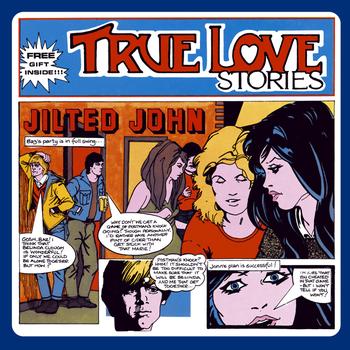
The song got to Number 4 in the British charts in the Summer of 1978, and pretty much became a one-hit wonder. There was an album, 'True Love Stories', released as well, which I remember seeing once in the old John Menzies shop in Stirling, but that was pretty much it. I recall once on some Saturday morning kids TV show that a young lad calling in to the show won a record token. When asked what he was going to buy with the token he replied 'Jilted John'. That was the last time I ever heard of Jilted John for years, even though the single was occasionally played on nostalgia shows.
I always wondered about that album though and recently searched on the Internet to see if it was out there for downloading.
It was, and as I sat down to listen to what I imagined would be a whole album of Punkish broad comedy novelty, something strange occurred....the album was good, very good in fact, and nothing like what I was expecting....
'True Love Stories' is pretty much a concept album, detailing 'John's life from pre-pubescence, through school, through his first love with Karen (not Julie as in the single), his fist parties, and then the break-up with Karen and his subsequent decision to leave home and head to London.
Two things strike you right away; the lyrics are fantastic, and the music is not the second rate Punk gruel you might expect. No, the music and Graham ('John')'s vocals conjure up comparisons with 'Parklife'-era Blur, pre-fame Pulp, Robyn Hitchcock, Felt (particularly 'The Pictorial Jackson Review' album), The Cardiacs, and most evidently for me (at least), Deep Freeze Mice and their off-shoot band The Chrysanthemums. And because of Graham's deeply personal heart-on-sleeve lyrics, there are also traces of The Field Mice, and indeed almost all Sarah Records! From Jilted John?? Who on Earth would have thunk it? And, as I'm sure I don't have to point out, Graham's album predated most of those other artists mentioned by nearly a decade!! Is Graham Fellow's alter-ego THE great influence on British Indie Pop? It may seem, and probably IS unlikely, but who knows how many of those other artists mentioned may have bought 'True Love Sories' on the back of the single, only to have some musical Trojan horse bring a melange of melancholic ennui and angst-driven hubris draped in a curious Lounge-Pop sheen (Griff: You're not writing for the Guardian, you know!) into their lives!
Let me give you an example; take the song 'Shirley' which is one of the last songs on the album and sees John trying to hitch-hike to London and being picked up by an attractive older woman....can't you hear Blur, can't you hear The Cardiacs? If you say can't hear The Chrysanthemums I'll understand because I know they're a little obscure....
If you grew up in the 1970s or early 80s then the albums reference points add that little bit of extra Proustian flashback. Take 'I Was A Pre-Pubescent' in which Graham gives us a snapshot critique of John's early life from birth to school. This is a fabulous song delivered beautifully, which could sum up anyone's life in Northern Britain at that time....including your scribe (although I wasn't born in 1959 obviously!)....
'The Paperboy Song' sees John leave school and get a paper round to supplement his dole money. This is where he first meets Karen (a pivotal moment in his life, as it would be in any young lad's life) and the song ends with a bit of scene setting which runs through the album, but not enough to spoil the music....
'True Love' continues with the theme....now John knows he is in love and gushes forth all the platitudes that take over your mind when you meet that first 'one'. This song is almost pure Felt, from the strummed guitar, through the sparkling keyboard runs, down to Graham's over enunciated delivery. Believe me, all C-86 influenced Pop begins here....
In the end, Karen breaks up the relationship as I mentioned earlier, and heads off to London leaving a heartbroken John in her pursuit.
The hit single therefore would feel somewhat incongruous as it doesn't fit the musical palette, nor does his break up with Julie and her subsequent relationship with Gordon. And indeed, the single doesn't appear! But what does appear is an alternative (I believe earlier) take of the song which includes all the same lyrics and ad-libs, but which fits more with the album's feel. Personally though, I find this the most disappointing track on the album. See what you think....
So there you have it, a nice, odd little Pop album a million miles away from what you may have expected. I now wonder what that young lad who was going to buy the album with his record token thought about the album? Maybe he grew up to be Damon Albarn!
As with any successful 'novelty' record (as Jilted John was seen by many), there were attempts to cash in on the single's success. Graham Fellows himself followed the album with a couple of singles as Gordon The Moron, none of which did anything. One of those singles, 'Sold On You' is actually a lovely piece of dream-pop which unfortunately I can't find on Youtube, however it does appear on the album as an extra track.
The most blatant cash-in however, was a dreadful record called 'Gordon's Not A Moron' by Julie & Gordon. Set up as a direct response to Jilted John's hit, this unlovely piece of work features the most moronic (hah! Irony!) third rate Punk grinding over which 'Julie' and 'Gordon' deliver their own attack on John in the broadest Cockney accents imaginable. Now....wasn't the whole thing supposed to have occurred down Salford way? Are there many broad Cockneys in North Lancashire? Believe me, I am more offended by this tripe than anything Jilted John ever uttered!!
Graham Fellows never repeated Jilted John's chart success, but carved out a career as an actor, even appearing in Coronation Street, before creating the character John Shuttleworth and appearing with Vic & Bob, Harry Hill and regularly playing at the Edinburgh Festival and on TV.
In an interview with the NME once, before donning John Shuttleworth's garb, Graham Fellows spoke about Jilted John and claimed he had people called Gordon approaching him all the time, telling him he ruined their lives. Cryptically he left the statement hanging, without giving any hint or clue as to why he chose that particular name to berate.
Well....he may have ruined other Gordons lives, but his 'True Love Stories' album certainly has enriched mine!
'Ere we go, 2...3...4!
~Gordon~
You can download the album 'True Love Stories' complete with bonus tracks here
Well let me start by saying that I think Jilted John is one of the great Pop/Punk singles of all time and, even though it should have ruined my life and made my childhood Hell, it never really had the damaging effect you might think. You see I was lucky in that the record was released when we were all on our school Summer holidays, and by the time we all got back, given that most kids have goldfish-like memories, it took a few a days before some wag finally twigged and decided to berate me with the chorus of "Gordon is a moron". But the simple truth was that I loved the song and, had it had ANY other name in the infamous chant section, it would probably rank as one of my favourite records of all time.
To the uninitiated, Jilted John was the titular song by a character created by actor and comedy songwriter Graham Fellows who would later become more successful as Northern Philosopher/Club Entertainer John Shuttleworth. The song, whilst deliberately Punk-by-numbers, is delivered in a whiny, heartbroken Mancunian accent, detailing the break up of John and his girlfriend Julie, and her subsequent new love Gordon. The lyrics drip with bitter vexation as John reels of a string of insults at Julie and Gordon, but contain just enough pathos to prevent the song becoming mean. Any heartbroken teenager will identify immediately with the splenetic vitriol on display. Back in the day when people used to tape-record the Top 40 off the radio, we used to have a chart countdown that had Jilted John and 'Ever Fallen In Love With Someone....' by The Buzzcocks, and it's actually surprising how similar the two songs are; Punk riffing tunes imbued with bleaty Mancunian vocals.
The song got to Number 4 in the British charts in the Summer of 1978, and pretty much became a one-hit wonder. There was an album, 'True Love Stories', released as well, which I remember seeing once in the old John Menzies shop in Stirling, but that was pretty much it. I recall once on some Saturday morning kids TV show that a young lad calling in to the show won a record token. When asked what he was going to buy with the token he replied 'Jilted John'. That was the last time I ever heard of Jilted John for years, even though the single was occasionally played on nostalgia shows.
I always wondered about that album though and recently searched on the Internet to see if it was out there for downloading.
It was, and as I sat down to listen to what I imagined would be a whole album of Punkish broad comedy novelty, something strange occurred....the album was good, very good in fact, and nothing like what I was expecting....
'True Love Stories' is pretty much a concept album, detailing 'John's life from pre-pubescence, through school, through his first love with Karen (not Julie as in the single), his fist parties, and then the break-up with Karen and his subsequent decision to leave home and head to London.
Two things strike you right away; the lyrics are fantastic, and the music is not the second rate Punk gruel you might expect. No, the music and Graham ('John')'s vocals conjure up comparisons with 'Parklife'-era Blur, pre-fame Pulp, Robyn Hitchcock, Felt (particularly 'The Pictorial Jackson Review' album), The Cardiacs, and most evidently for me (at least), Deep Freeze Mice and their off-shoot band The Chrysanthemums. And because of Graham's deeply personal heart-on-sleeve lyrics, there are also traces of The Field Mice, and indeed almost all Sarah Records! From Jilted John?? Who on Earth would have thunk it? And, as I'm sure I don't have to point out, Graham's album predated most of those other artists mentioned by nearly a decade!! Is Graham Fellow's alter-ego THE great influence on British Indie Pop? It may seem, and probably IS unlikely, but who knows how many of those other artists mentioned may have bought 'True Love Sories' on the back of the single, only to have some musical Trojan horse bring a melange of melancholic ennui and angst-driven hubris draped in a curious Lounge-Pop sheen (Griff: You're not writing for the Guardian, you know!) into their lives!
Let me give you an example; take the song 'Shirley' which is one of the last songs on the album and sees John trying to hitch-hike to London and being picked up by an attractive older woman....can't you hear Blur, can't you hear The Cardiacs? If you say can't hear The Chrysanthemums I'll understand because I know they're a little obscure....
If you grew up in the 1970s or early 80s then the albums reference points add that little bit of extra Proustian flashback. Take 'I Was A Pre-Pubescent' in which Graham gives us a snapshot critique of John's early life from birth to school. This is a fabulous song delivered beautifully, which could sum up anyone's life in Northern Britain at that time....including your scribe (although I wasn't born in 1959 obviously!)....
'The Paperboy Song' sees John leave school and get a paper round to supplement his dole money. This is where he first meets Karen (a pivotal moment in his life, as it would be in any young lad's life) and the song ends with a bit of scene setting which runs through the album, but not enough to spoil the music....
'True Love' continues with the theme....now John knows he is in love and gushes forth all the platitudes that take over your mind when you meet that first 'one'. This song is almost pure Felt, from the strummed guitar, through the sparkling keyboard runs, down to Graham's over enunciated delivery. Believe me, all C-86 influenced Pop begins here....
In the end, Karen breaks up the relationship as I mentioned earlier, and heads off to London leaving a heartbroken John in her pursuit.
The hit single therefore would feel somewhat incongruous as it doesn't fit the musical palette, nor does his break up with Julie and her subsequent relationship with Gordon. And indeed, the single doesn't appear! But what does appear is an alternative (I believe earlier) take of the song which includes all the same lyrics and ad-libs, but which fits more with the album's feel. Personally though, I find this the most disappointing track on the album. See what you think....
So there you have it, a nice, odd little Pop album a million miles away from what you may have expected. I now wonder what that young lad who was going to buy the album with his record token thought about the album? Maybe he grew up to be Damon Albarn!
As with any successful 'novelty' record (as Jilted John was seen by many), there were attempts to cash in on the single's success. Graham Fellows himself followed the album with a couple of singles as Gordon The Moron, none of which did anything. One of those singles, 'Sold On You' is actually a lovely piece of dream-pop which unfortunately I can't find on Youtube, however it does appear on the album as an extra track.
The most blatant cash-in however, was a dreadful record called 'Gordon's Not A Moron' by Julie & Gordon. Set up as a direct response to Jilted John's hit, this unlovely piece of work features the most moronic (hah! Irony!) third rate Punk grinding over which 'Julie' and 'Gordon' deliver their own attack on John in the broadest Cockney accents imaginable. Now....wasn't the whole thing supposed to have occurred down Salford way? Are there many broad Cockneys in North Lancashire? Believe me, I am more offended by this tripe than anything Jilted John ever uttered!!
Graham Fellows never repeated Jilted John's chart success, but carved out a career as an actor, even appearing in Coronation Street, before creating the character John Shuttleworth and appearing with Vic & Bob, Harry Hill and regularly playing at the Edinburgh Festival and on TV.
In an interview with the NME once, before donning John Shuttleworth's garb, Graham Fellows spoke about Jilted John and claimed he had people called Gordon approaching him all the time, telling him he ruined their lives. Cryptically he left the statement hanging, without giving any hint or clue as to why he chose that particular name to berate.
Well....he may have ruined other Gordons lives, but his 'True Love Stories' album certainly has enriched mine!
'Ere we go, 2...3...4!
~Gordon~
You can download the album 'True Love Stories' complete with bonus tracks here
Thursday, 2 August 2012
Griff says; Come and stand for peace.
Next Monday, August 6th., is marked as Hiroshima Day by peace campaigners all over the world. Hiroshima Day marks the day in 1945 when an atomic bomb was dropped on the Japanese city of Hiroshima, followed a few days later by another dropped on the city of Nagasaki.
Hiroshima Day, as well as commemorating the needless destruction of a city and its population, is now a focus for anti-war and anti-nuclear discussions and demonstrations. The Scottish Campaign for Nuclear Disarmament will be holding events across the length and breadth of Scotland. There will be gatherings in Glasgow, Edinburgh, Bridge of Allan, Aberdeen, Dundee, Irvine, Kilmarnock, Rutherglen, Inverness and Paisley. See 'here' for more details. Needless to say, 'The Streetlamp' will be attending at least one of the events and we urge any of our readers to find out where Hiroshima Day is being commemorated in their own locality and going along to take part.
If you are unable to do so then please, if you live in Scotland, show support for Scottish CND by supporting their Nae Nuclear Weapons Here Campaign. All Scottish CND want people to do is to add a pin to their map to show that people in every corner of this country want to see nuclear disarmament. Add your pin 'here'.
As well as urging you to commemorate Hiroshima Day we would like to bring your attention to the work of Nâzim Hikmet. Hikmet was a Turkish poet, playwright and novelist who was repeatedly arrested for his political beliefs and spent much of his adult life in prison or in exile. A good selection of his work can be found at the Marxists Internet Archive. He is most well known in this country for the poem Kiz Çocugu (The Little Girl). This poignant piece, written in 1956, conveys a plea for peace from a seven-year-old girl, ten years after she has perished in the atomic bomb attack at Hiroshima. This poem is known in English by various other titles, including "I come and Stand at Every Door" and "Hiroshima Girl" and has been set to music and covered by numerous artists. In this writer's opinion, the most moving version is the rendition by This Mortal Coil from their 1991 album Blood. The breathtaking vocals on this version are by well-known Glaswegian singing sisters Louise and Deirdre Rutkowski along with Tim Freeman.
The images in this video are, of course, from the 1983 anime Hadashi no Gen (Barefoot Gen), itself based on the seminal, Japanese, manga series by Hiroshima survivor Keiji Nakazawa. If you've never seen this film, a free version of the entire film with an English dub can be found 'here'.
The English translation of the poem used here is provided below:
An MP3 of this song can be downloaded 'here'.
Griff
Hiroshima Day, as well as commemorating the needless destruction of a city and its population, is now a focus for anti-war and anti-nuclear discussions and demonstrations. The Scottish Campaign for Nuclear Disarmament will be holding events across the length and breadth of Scotland. There will be gatherings in Glasgow, Edinburgh, Bridge of Allan, Aberdeen, Dundee, Irvine, Kilmarnock, Rutherglen, Inverness and Paisley. See 'here' for more details. Needless to say, 'The Streetlamp' will be attending at least one of the events and we urge any of our readers to find out where Hiroshima Day is being commemorated in their own locality and going along to take part.
If you are unable to do so then please, if you live in Scotland, show support for Scottish CND by supporting their Nae Nuclear Weapons Here Campaign. All Scottish CND want people to do is to add a pin to their map to show that people in every corner of this country want to see nuclear disarmament. Add your pin 'here'.
As well as urging you to commemorate Hiroshima Day we would like to bring your attention to the work of Nâzim Hikmet. Hikmet was a Turkish poet, playwright and novelist who was repeatedly arrested for his political beliefs and spent much of his adult life in prison or in exile. A good selection of his work can be found at the Marxists Internet Archive. He is most well known in this country for the poem Kiz Çocugu (The Little Girl). This poignant piece, written in 1956, conveys a plea for peace from a seven-year-old girl, ten years after she has perished in the atomic bomb attack at Hiroshima. This poem is known in English by various other titles, including "I come and Stand at Every Door" and "Hiroshima Girl" and has been set to music and covered by numerous artists. In this writer's opinion, the most moving version is the rendition by This Mortal Coil from their 1991 album Blood. The breathtaking vocals on this version are by well-known Glaswegian singing sisters Louise and Deirdre Rutkowski along with Tim Freeman.
The images in this video are, of course, from the 1983 anime Hadashi no Gen (Barefoot Gen), itself based on the seminal, Japanese, manga series by Hiroshima survivor Keiji Nakazawa. If you've never seen this film, a free version of the entire film with an English dub can be found 'here'.
The English translation of the poem used here is provided below:
I come and stand at every door
But no one hears my silent tread
I knock and yet remain unseen
For I am dead, for I am dead.
I'm only seven although I died
In Hiroshima long ago
I'm seven now as I was then
When children die they do not grow.
My hair was scorched by swirling flame
My eyes grew dim, my eyes grew blind
Death came and turned my bones to dust
And that was scattered by the wind.
I need no fruit, I need no rice
I
need no sweet, nor even bread
I ask for nothing for myself
For I am dead, for I am dead.
All that I ask is that for peace
You fight today, you fight today
So that the children of this world
May live and grow and laugh and play.
An MP3 of this song can be downloaded 'here'.
Griff
Subscribe to:
Posts (Atom)